Aftercare Instructions
Mixing your own sea salt solution is no longer a suggested practice from the APP. Mixing your own sea salt solution will commonly result in the product being far too salty and strong, this can over dry the piercing and interfere with healing. We strongly encourage you to use a sterile saline, labeled for use as a wound wash. Your saline ingredients should list 0.9% sodium chloride as the only ingredient (sometimes purified water will be listed). Additives like moisturizers and antibacterials should be avoided, as well as similar sounding products like contact lens saline, nasal spray, or eye drops.
Cleaning steps using warm, running water:
If sterile saline is not available in your region, focus on keeping the piercing clean by rinsing well during regular showering. . Check in with a local piercer for additional regional aftercare suggestions.
At the end of a shower routine use clean, warm, running water to irrigate your piercing thoroughly (for 1-2 mins.) to help remove any soaps & soften build-up. Please avoid moving or rotating jewelry as it can cause more harm to the healing process.
Wash hands thoroughly before and after interacting with a fresh piercing.
Clean & Dry the piercing site with a single-use disposable product such as gauze, paper towels or pointed cotton swabs to gently remove any build-up. (Pat dry after)
If any build up persists, repeat step 2. & 3.
Do this step once a day.
For Cleaning steps using a Sterile Saline Wound Wash(0.9% Sodium Chloride & Water)
Wash hands thoroughly before and after interacting with a fresh piercing.
Directly point the nozzle at the piercing site, flush and irrigate for a few seconds, let the saline sit (3-5 mins) to soften the debris.
Clean & Dry the piercing site with a single-use disposable product such as gauze, paper towels or pointed cotton swabs to gently remove any build-up. (Pat dry after)
If any build up persists, repeat step 2. & 3.
Do these steps 2 times a day.
Using Soaps:
If you choose to use soap on a healing piercing consider using a gentle soap free from harsh chemicals, dyes, and perfumes. The use of an antibacterial soap is not suggested as it may over-dry and irritate your piercing. If your piercer suggests the use of a soap, be sure to fully rinse away the product after use.
What to expect after getting a new piercing?
Initially: bleeding for the first few days, localized swelling, tenderness, and/or bruising. (May vary depending on if trauma occurs)
During healing: Discoloration, itching, secretion of a whitish-yellow fluid that will exude from the piercing site then form crust on the jewelry. The tissue may tighten around the jewelry as it heals. A piercing may seem healed before the normal healing duration this is because the wound heals from the outside, in. Although it may feel fine on the outside the interior could still be fragile, do not sleep on the piercing. Be patient, and keep cleaning throughout the entire initial healing period.
Once healed: The jewelry may not move freely in the piercing; do not force or shift it. Clean the debris. Cleaning your piercings as part of your normal hygiene routine can help them stay clean as well avoid having normal, smelly, secretions accumulate.
Tip: Piercings, even long term healed ones, may shrink or close within minutes! This varies from person to person— do not leave the piercing out.
Referenced from the Association of Professional Piercers (2023)
Hints and Tips
During healing, do not twist, spin, or rotate your jewelry. (May cause micro tears)
Exercise and sweating during healing is fine. Avoid activities that could jostle or aggravate the piercing. Keep the piercing protected from bacteria present on gym equipment or exercise mats.
Make sure your bedding is washed and changed regularly. Wear clean, comfortable clothing that protects your piercing while you are sleeping.
Unless there is a problem with the size, style, or material of the initial jewelry, leave it in place for the entire healing process. For downsizing book an appointment.
Non-metallic jewelry can be worn if your metal jewelry must be temporarily removed. (Swap out for glass retainers)
In the event an infection is suspected, discuss what is required with your doctor
For Particular Areas
Ear/Ear Cartilage and Facial:
Avoid sleeping directly on an ear piercing try using a travel pillow or a pillow designed to avoid ear pressure. (such as a donut/ piercing pillow) You may also try to lay flat on your pillow/bed and use a clean t-shirt or pillowcase tucked into the center to keep a clean surface for your new piercing, or ditching your pillows and create a space in your arm to keep your ear. afloat.
Hard surfaces like phones, headphones, eyeglasses, etc. can be cleaned with a disinfectant to prevent any spread of bacteria. DO NOT use these if it causes pressure on your piercings. Items like hats, scarves, headbands, etc should be washed regularly.
Ear plastic “caps” can be used when getting your hair styled to prevent any excess product build-up and snagging of your new piercing.
Oral Piercings:
Due to increased blood flow, oral piercings tend to experience high-levels of swelling.
Follow standard oral hygiene.
Rinsing with a sterile saline wound wash can help reduce irritation and clean the piercing site — rinse after brushing.
Rinsing with clean water after eating can help irrigate debris leftover from eating.
Rinsing with zero alcohol mild taste Listerine throghout the day will help with bacteria.
Be sure to follow up and downsize your piercing, it is crucial for the rest of your healing process.
Navel:
Avoid high waisted/ tight clothing as it puts pressure and prevents oxygen to the piercing site you may use a hard vented eye patch to avoid excess irritation, physical trauma from activities like sports. You can use non-adhesive elastic/ACE-type bandages or tights/stockings to secure it in place.
Avoid seatbelts from getting snagged.
Avoid sleeping directly on your stomach and side as it may migrate the piercing.
Surface Bars/ Anchors:
These piercings are a long term temporary piercing that requires care for the duration of their lifespan.
Dead skin and sebum will build up underneath the threaded top causing the piercing to get irritated and possibly cause migration or even rejection. Do saline and warm water rinses to help soften any build-up for an easy removal.
Avoid putting makeup on these piercings even after healing.
Wearing band-aids at night, loosely (DO NOT suffocate the piercing) to avoid any snagging.
Things you shouldn’t do while healing your piercing:
Avoid sleeping or applying pressure. This includes being cautious of bedding/pillows, ear/headphones, stethoscopes, or anything else that presses against your piercings, as it can also cross contaminate bacteria to the wound.
Avoid harsh chemicals and products such as soaps, fragrances, rubbing alcohol, hydrogen peroxide, iodine, oils, lotions, or ointments during the healing.
Avoid Bactine®, pierced ear care solutions, and other products containing Benzalkonium Chloride (BZK). These can be irritating and are not intended for long-term wound care.
Avoid over-cleaning. This can delay your healing and irritate your piercing.
Avoid unnecessary movement and contact with your piercing.
If you’re doing something that hurts your piercing find an alternative & contact for help!
Disclaimer: These guidelines are based on a combination of vast professional experience, common sense, research, and extensive clinical practice. This is not to be considered a substitute for medical advice from a doctor. If you suspect an infection, seek medical attention. Be aware that many doctors have not received specific training regarding piercing. Your local piercer may be able to refer you to a piercing-friendly medical professional. For more information, see the APP Brochure Troubleshooting For You and Your Healthcare Professional. Use of this brochure does not imply membership in the APP. A current list of APP members can be found at safepiercing.org.
18 + Aftercare Instructions
Nipple:
Nipple piercings are for looks and not play for the duration of the healing period.
Wear what is comfortable, avoid items that make your piercing sore or tender after wear.
A snug cotton top or bralette may provide protection and help the piercings breathe. DO NOT sleep on the piercings. Be mindful of washing with wash cloths & Loofahs.
Genital Piercing:
Genital Piercings – especially Triangles, Prince Alberts, Ampallangs, and Apadravyas – can bleed freely for the first few days. Be prepared. Additional cleaning after urination is not necessary
Wash your hands before touching (directly or near-by) a healing piercing.
In most cases you can engage in sexual activity as soon as you feel ready, but maintaining hygiene and avoiding trauma are vital; all sexual activities should be gentle during the healing period.
Use barriers such as condoms, dental dams, and waterproof bandages, etc. to avoid contact with your partners’ body fluids, even in long-term monogamous relationships.
Use protection on sex toys, too.
Use a new container of water-based lubricant; do not use saliva.
Showering after intercourse is suggested.
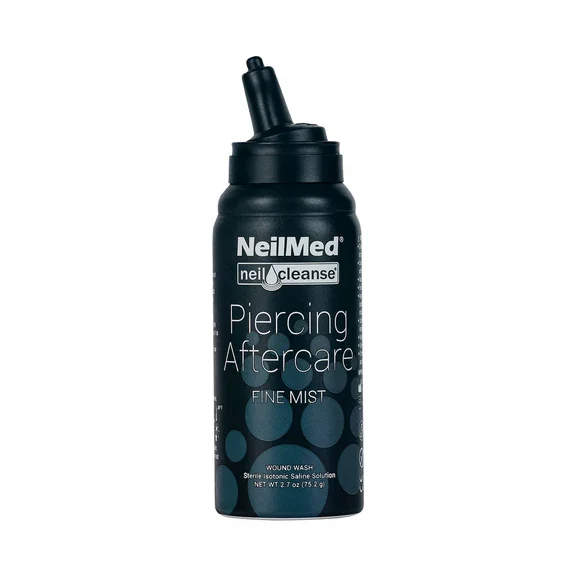
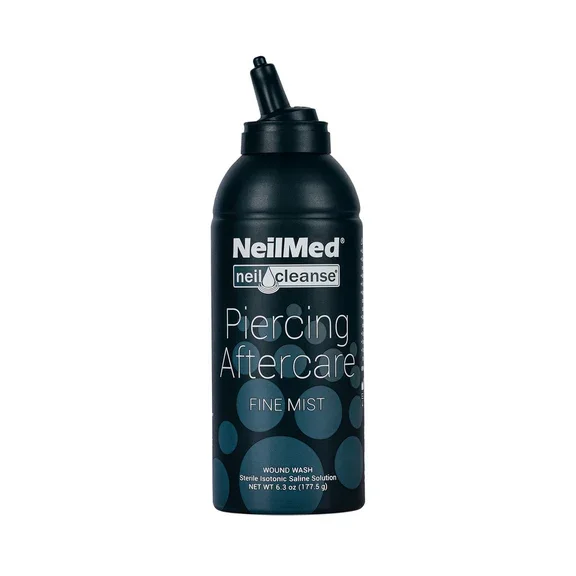
NeilMed Piercing Aftercare allows users to spray a saline solution directly onto their piercing rather than soak it in a saline bath or having to use a cotton ball. This creates a more sterile application process and offers a cleaning solution that makes it easy to clean surface piercings like cartilage piercings. Sprays in any position, including when inverted.
75mL travel size canister or 177mL full size canister
Sterile, drug free, and preservative free
No burning or stinging
Portable, convenient for travel or on-the-go
Note: The 75mL canister comes in the perfect size to fit in your bag so that you can conduct aftercare while on-the-go. It also adheres to TSA standards so that you can take it with you in your carry on.